News
Autonomous A2RL Race Cars Hold Europe's First Such Race at Imola
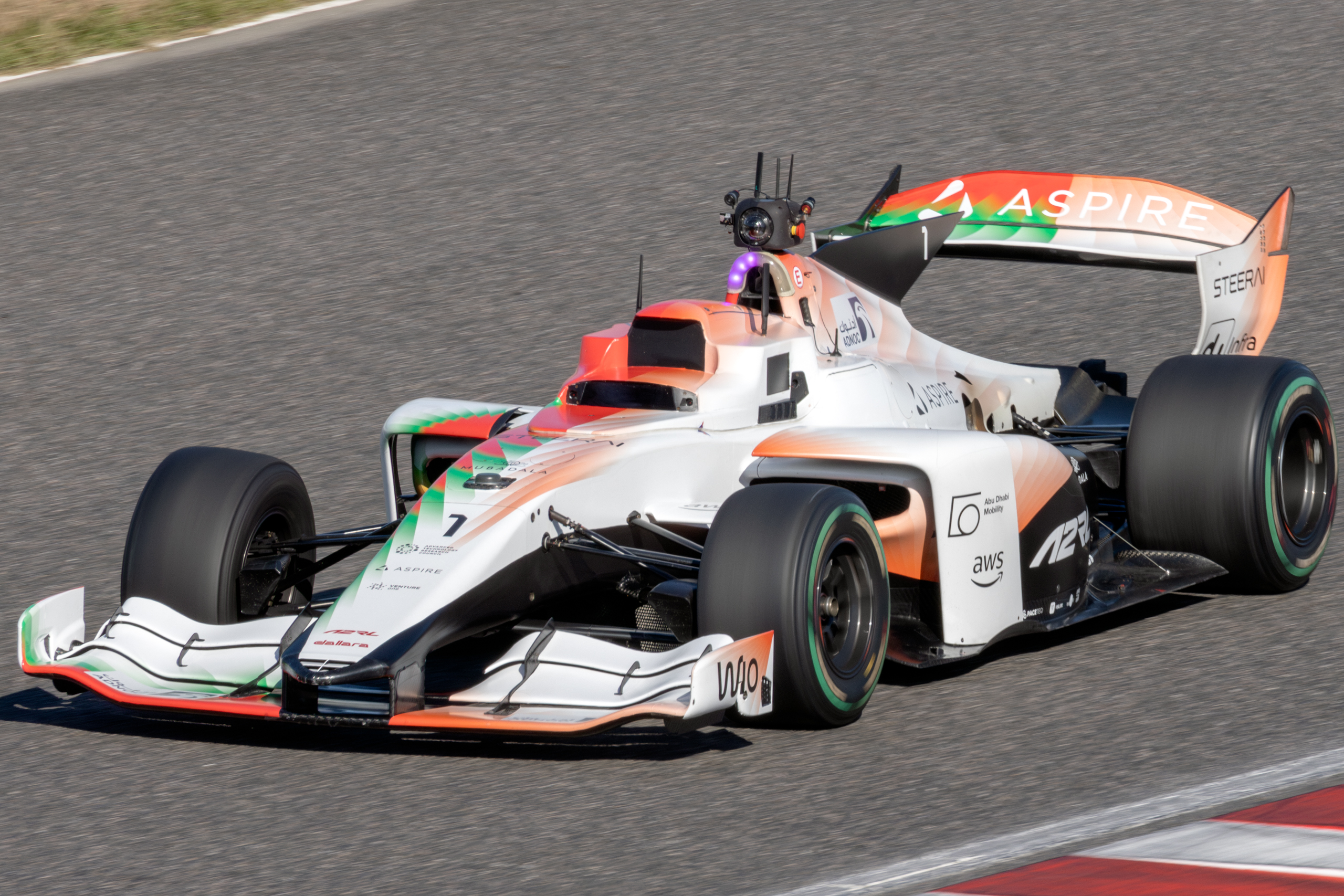
Five fully autonomous race cars competed on September 5 at Italy's Imola circuit, with victory decided by a crash involving the race leader. It was the first international round of the Abu Dhabi Autonomous Racing League held outside the Persian Gulf.
On Italy's famous Imola circuit, five driverless cars competed in the first multi-car autonomous race ever held in Europe. The event was organized by the Abu Dhabi Autonomous Racing League (A2RL), which after two seasons at the Yas Marina Circuit in Abu Dhabi ventured outside the Persian Gulf for the first time, with the race's outcome decided by a technical failure suffered by the leader and a crash that eliminated two teams at once.
How the Race Played Out
The race covered 12 laps of one of the most technically demanding circuits in world motorsport. Unimore took pole position and led the field for most of the distance, setting the race's fastest lap at 1:40. Right behind it, less than a second back, was PoliMOVE, which reached the day's top speed of 252.3 km/h.
Unimore's car then suffered a technical fault and suddenly slowed on track. The autonomous system of PoliMOVE, running right behind it, failed to react in time and struck the rear of the slowing leader, eliminating both teams from the rest of the competition. The collision opened the way to victory for the Kinetiz team from the United Arab Emirates, which took the lead and held it to the finish.
Same Hardware, Different Software
A core premise of A2RL is that all five cars run on identical hardware, the EAV-25 platform built on the Dallara Super Formula SF23 chassis. That means the only factor separating teams' results is software: their systems for perceiving the environment, planning trajectories, controlling the car, and making real-time decisions. The format is meant to turn the series into a testing ground for autonomous driving technology rather than a contest between mechanical engineers.
The Imola race was organized by ASPIRE, operating under the Advanced Technology Research Council (ATRC), Abu Dhabi's government body responsible for advancing technology development. The round took place as part of the ACI Racing Weekend, with the field made up of the top five teams from the previous season's finale held in November in Abu Dhabi: defending champion TUM of Germany, Italian teams PoliMOVE and Unimore, Germany's Constructor Racing, and the UAE's Kinetiz.
From Abu Dhabi to Europe
A2RL debuted in April 2024 at the Yas Marina Circuit in Abu Dhabi, where eight autonomous race cars competed for a $2.25 million prize pool in front of more than 10,000 spectators on site and 600,000 watching online. Since then the series has grown from four-car races to a six-car grand final, and the lap-time gap between the best AI systems and professional drivers has narrowed from 10 seconds in 2024 to 1.58 seconds in 2025.
The Imola outing is the first step toward the organizers' ambition of making A2RL the world's first international championship for fully autonomous race cars. Imola's narrow racing line, limited runoff areas, elevation changes, and difficult overtaking spots made it a demanding test for the perception and decision-making systems of driverless cars.
This is a very proud moment for all of us at Kinetiz, to win the first international A2RL race and, most importantly, to represent the United Arab Emirates on the international stage. - Omar Hanif Alqassim, Kinetiz team principal
Bringing A2RL to Imola is an important milestone in our ambition to build the world's first international championship for fully autonomous race cars. - Stephane Timpano, CEO of ASPIRE
What's Next
The 2026 season will close with a return to the Yas Marina Circuit in Abu Dhabi, where A2RL was founded in 2024. Organizers say the lessons from Imola will feed into the further development of Abu Dhabi's autonomous systems research and development programs, and the Unimore-PoliMOVE collision is likely to be examined in safety reviews ahead of the series' next rounds.
For observers of the automotive and technology industries, the Imola race points to where testing of autonomous driving systems is heading, from closed circuits in the Persian Gulf to Europe's most demanding tracks, with academic and commercial teams from Italy, Germany, and the United Arab Emirates taking part. The crash that decided the outcome is also a reminder that AI systems still have limits in reacting to sudden, unusual events on track under racing conditions.