News
Claude Code Autonomously Optimized a Brain-Computer Interface for an ALS Patient
A Japanese researcher tasked Claude Code with optimizing a brain-computer interface for an ALS patient - the AI assistant wrote and tested 23 scripts in 24 hours, nearly doubling the patient's communication speed.
Contents
A researcher at the University of Tokyo has described, in a peer-reviewed scientific journal, a case in which the coding assistant Claude Code autonomously optimized a brain-computer interface used by a patient with amyotrophic lateral sclerosis (ALS). For roughly a day, the AI generated and tested successive versions of the algorithm with almost no human supervision, ultimately nearly doubling the patient's communication speed.
Brain-computer interfaces based on auditory event-related potentials (ERP-BCI) have long been one of the few communication channels for people with ALS, who in advanced stages of the disease lose control of all muscles, including their eyes. The problem is that each patient produces a different brain signal, so tuning a classification algorithm to a specific person requires tedious, manual work by engineers and typically takes weeks.
How the experiment worked
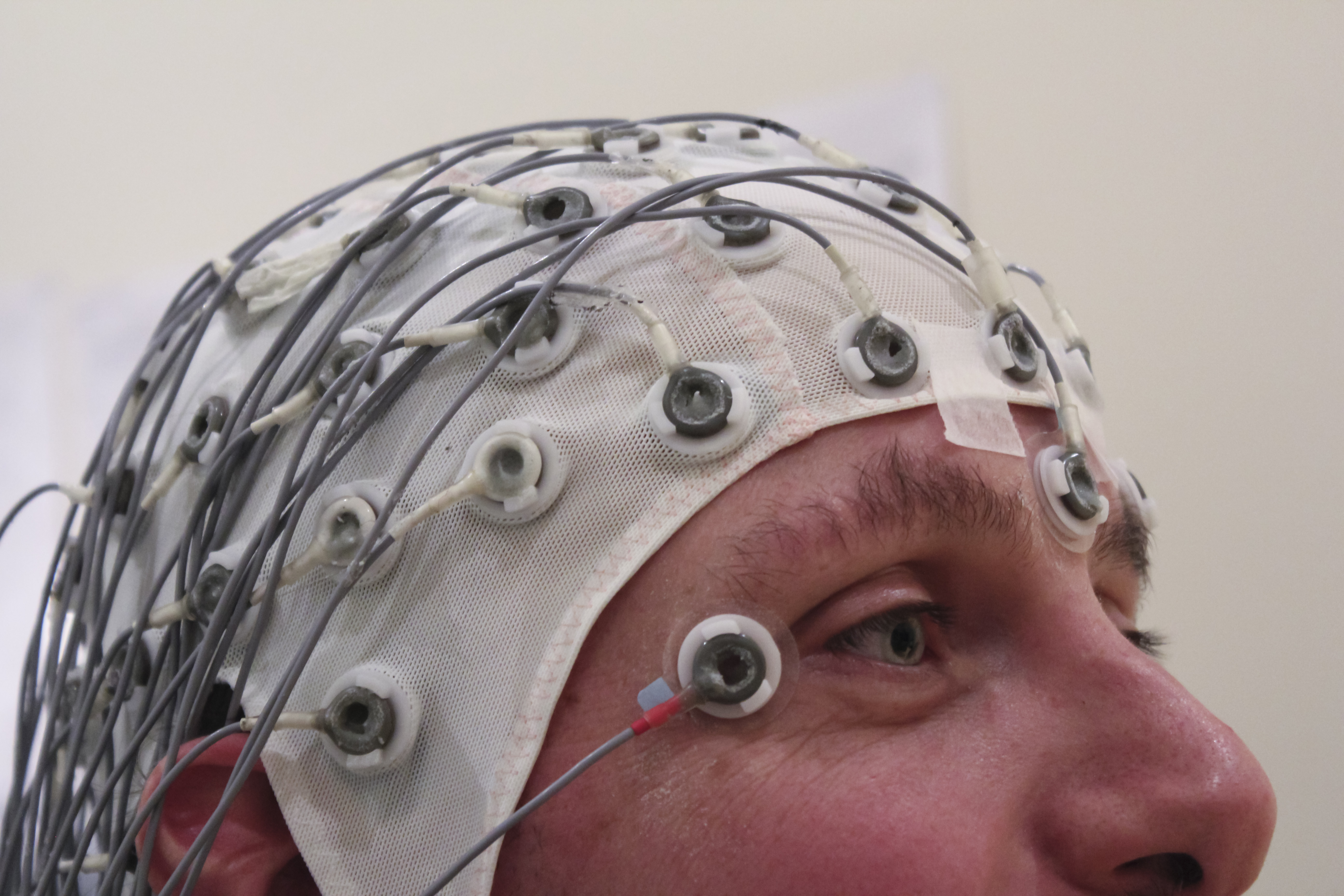
The patient, a man with ALS, took part in ten recording sessions between 2022 and 2026, during which his brain activity was recorded with an eight-channel OpenBCI Cyton EEG device at a 250 Hz sampling rate. The system played him three pure tones at 524, 708 and 932 Hz, corresponding to left, center and right directions, along with periods of silence. This produced 189 signal trials.
Instead of manually tuning the classifier's parameters, the researcher gave Claude Code permission to write and run code on its own, then largely stepped back from the process. The only human intervention during the entire experiment was a brief command to restart the tool after it ran out of API token budget.
What the AI came up with
Over the course of a day, Claude Code wrote and tested 23 successive versions of the signal-processing pipeline, independently judging which architecture produced the best results. The final solution, named AIDE in the paper, relies on two feature bands: a very low sub-delta frequency band (0.21-2.01 Hz), from which normalized mean differences reflecting the shape of the ERP waveform are extracted, and a gamma band (0.21-39 Hz), from which the logarithmic variance of signal power is drawn.
For classification, the AI chose linear discriminant analysis with Ledoit-Wolf regularization, and it tuned hyperparameters using Optuna's Bayesian search method. This solution, which no human designed by hand from scratch, turned out in practice to outperform the earlier model based on a classic SVM classifier.
Numbers with clinical significance
The difference between 70 and 85 percent classification accuracy might not sound like a breakthrough, but in practice it means the patient can communicate with fewer stimulus repetitions, which directly translates into less fatigue. The information transfer rate rose from 1.43 to 2.92 bits per minute, nearly doubling, and the time needed to make a single choice dropped from about 34 to 17 seconds.
For someone who is completely paralyzed and relies on a brain-computer interface as the only channel of contact with the world, an improvement like this means less fatigue during longer conversations and the ability to convey more information in the same amount of time. The study's author stresses that the research involved a single patient, so it is too early to call this a method ready for widespread deployment.
Claude Code autonomously optimized the signal-processing pipeline of a three-class auditory ERP-BCI for a single ALS patient, achieving reliable classification with half as many stimulus repetitions - from the study description in Frontiers in Human Neuroscience
Limitations and significance for the field
The work has the status of a proof of concept, not a finished medical product. A single patient, a single EEG device and a single set of experimental parameters do not allow conclusions about the method's effectiveness in other patients, whose brain signals may look completely different. Even so, the study points to a direction precision medicine supported by coding agents could take: instead of weeks of engineering work to fit an algorithm to one person, the task can be handed to an AI model and left to iterate solutions on its own over the course of a day.
For developers of BCI systems, this points to potentially shorter deployment times for personalized interfaces, which matters especially in rapidly progressing diseases like ALS, where the window for effective communication with a patient keeps narrowing. The author also notes that human oversight was minimal, which raises questions about how to document and verify decisions made autonomously by a model in medical contexts.
The study fits into a broader trend of using coding agents outside typical programming applications, from life sciences to biomedical engineering. In this case, the result is not a new app or a streamlined corporate process, but a concrete, measurable improvement in one patient's quality of life, documented in a peer-reviewed scientific journal.