News
Viral 'Autonomous Shanghai Port' Video Was Actually Filmed in California
A video watched more than half a million times as supposed proof of China's lead in port automation actually shows Long Beach, California. Real progress in autonomous transport in China is happening elsewhere, in a fleet of 100 electric trucks at the Yimin coal mine.
Contents
Recently a video has been circulating on social media presented as proof that China has left the West far behind in transport automation. It shows dozens of unmanned vehicles moving containers around a port terminal without a single visible worker. The clip has been viewed more than half a million times, captioned to suggest it shows the port of Shanghai. Journalists from Konkret24, the fact-checking service run by TVN24, traced the source and found that the footage actually shows a terminal in Long Beach, California, not China.
A false lead from California
Konkret24 compared frames from the viral video with promotional material from the Long Beach Container Terminal and found identical terminal architecture, the same distinctive crane structures, and the same green transport platforms used to move containers. The difference is the time of day: the clip circulating online was filmed in the evening or at night, while the official company footage was shot during the day, which made it harder for some viewers to recognize the location.
The Long Beach terminal does in fact operate almost entirely without human involvement. It uses autonomous electric vehicles that carry containers weighing up to 70 tons between the quay and the storage yard, and swapping their batteries at a charging station takes about five minutes. It's real technology, just not Chinese, and not from the port the viral caption claimed.
Real automation in Inner Mongolia
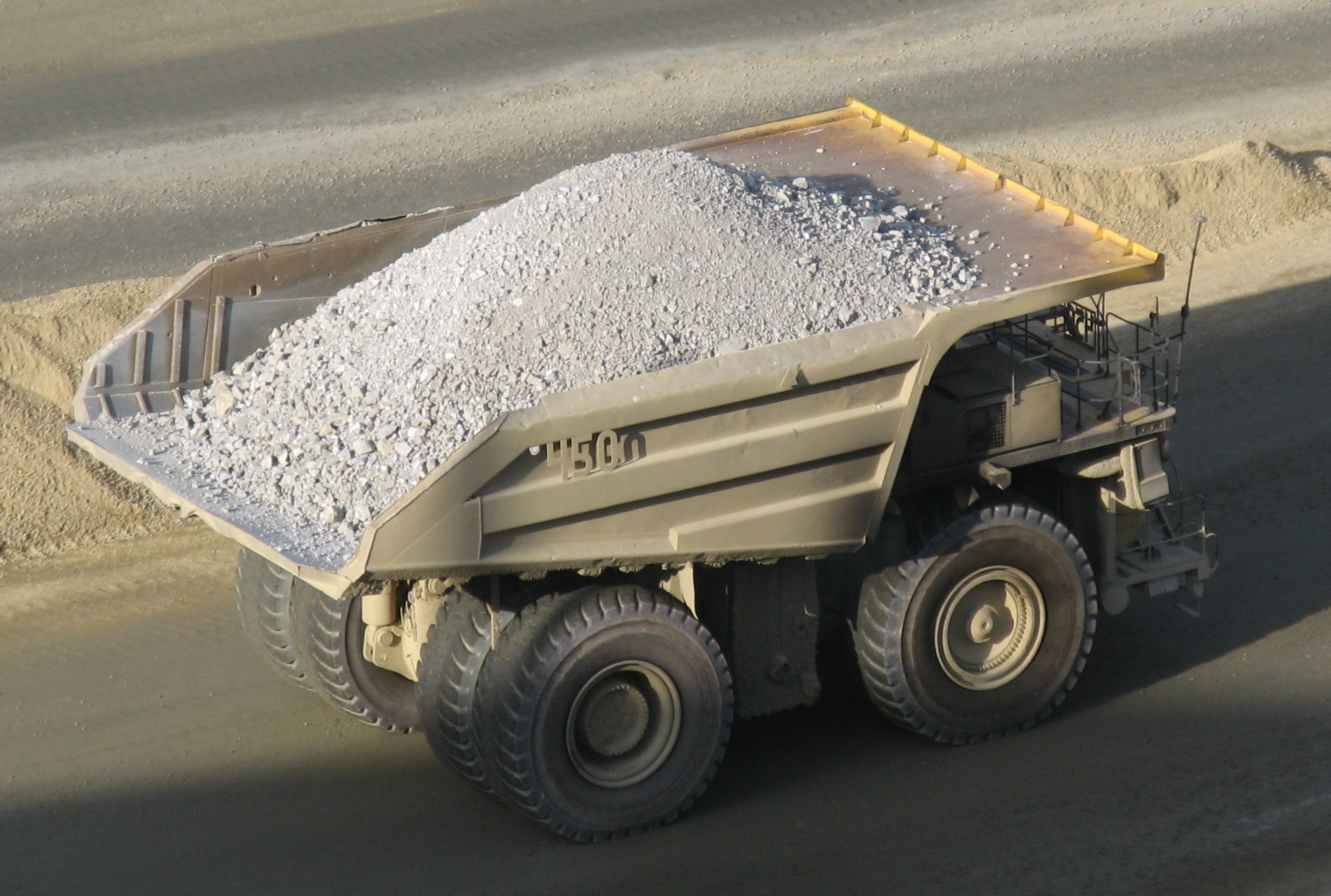
Genuine, well-documented transport automation in China is happening somewhere else entirely, and in a different industry. At the Yimin open-pit mine in Inner Mongolia, owned by the China Huaneng Group, a full fleet of 100 autonomous, fully electric mining trucks called Huaneng Ruichi has been operating since May 2025. The rollout followed years of testing: the first trials with converted diesel trucks began in 2020, and autonomous operation in the open pit started in 2022, once the site was covered by 5G.
The vehicles run on a 5G-A network built by Huawei and China Mobile, offering throughput of up to 500 Mb/s and latency of around 20 milliseconds thanks to three-carrier aggregation technology. The environment-sensing system provides visibility up to 40 meters in darkness or during sandstorms, using radar and cameras that give a full 360-degree view. Each truck carries a 568 kWh lithium iron phosphate battery, and swapping it takes just a few minutes.
Fleets of this kind operate in the extreme climate of Inner Mongolia, withstanding temperatures as low as minus 48.5 degrees Celsius. The system's efficiency rose gradually, from 87 percent of a human driver's output in the first trials to 120 percent in 2024, when nine electric trucks hauled a combined 1.3 million cubic meters of material during the pilot phase. The operator plans to expand the fleet to 300 vehicles within three years.
The race for automated mining
Yimin is China's second-largest open-pit mine, with an annual production capacity of 35 million tons of coal. Inner Mongolia alone accounts for roughly a quarter of the country's coal output, so automating transport in the region has a direct impact on costs and worker safety across China's entire raw materials sector, not just a technology showcase for public relations.
Autonomous mining trucks eliminate the risk of accidents caused by driver fatigue and allow continuous operation, without the breaks labor law requires for human crews. Unlike fully automated container terminals, which have already been running for years in Asia as well as in the United States and Europe, autonomous mining transport systems on this scale remain rare worldwide, which makes the Yimin deployment a genuine benchmark for the industry.
A viral video as a propaganda tool
The fact that Shanghai has had a fully automated container terminal, the Yangshan Deep Water Port, running since April 2018 made it easier for the false caption on the California footage to spread. Viewers who had already heard about China's automated ports were inclined to believe they were seeing further proof of the same trend, even though the specific clip showed a completely different continent.
This case illustrates a pattern that repeats across many viral technology clips: a real, impressive achievement in one part of the world becomes the pretext for captioning an entirely different, unrelated video. The effect is the same regardless of the caption writer's intent: viewers draw a false conclusion about the scale and location of a real technology, and verifying it requires comparing architectural details frame by frame, exactly as Konkret24's journalists did.