News
AI Fully Reads a 2,000-Year-Old Herculaneum Scroll for the First Time
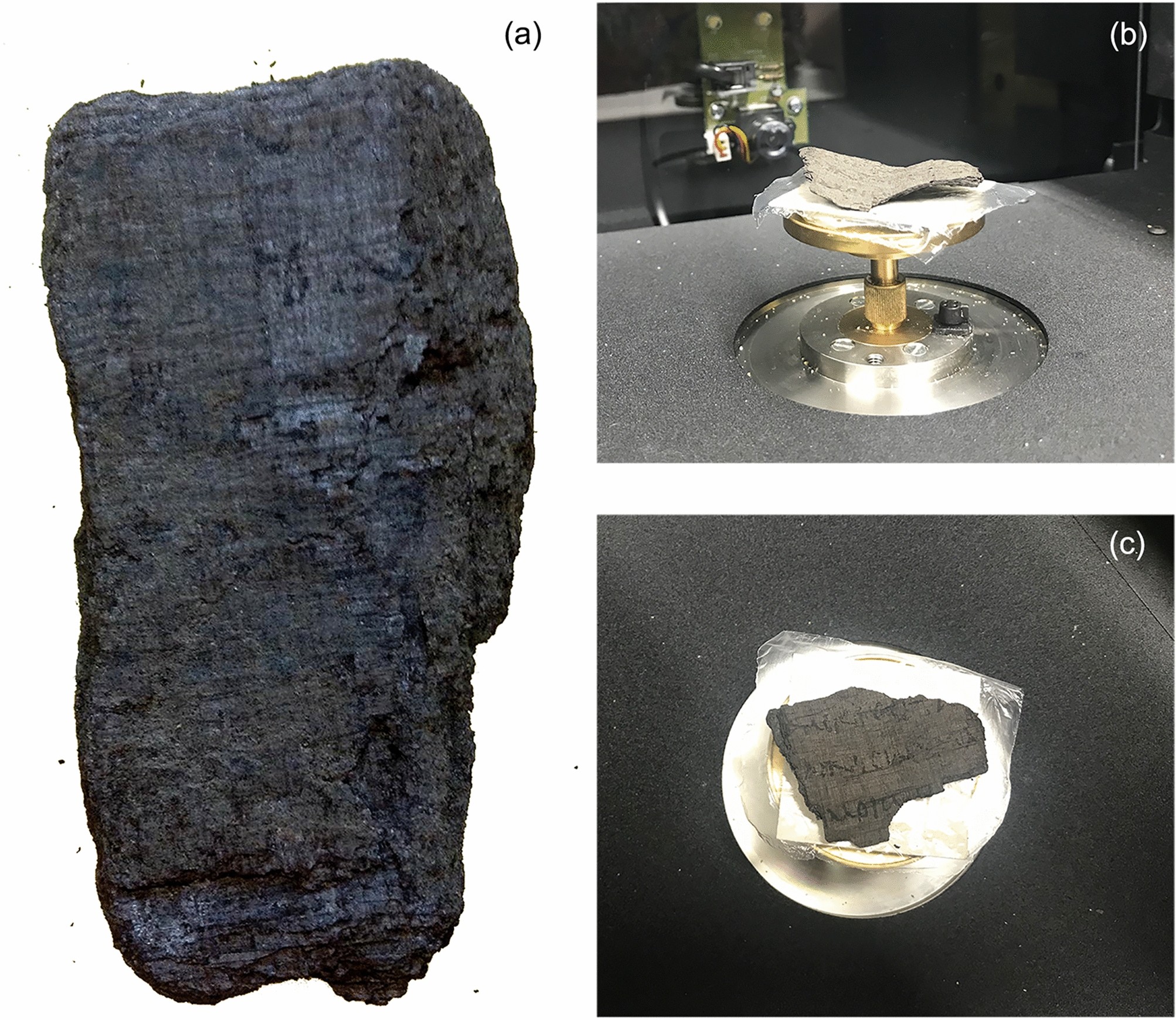
The Vesuvius Challenge team has read a carbonized scroll from a Roman villa in Herculaneum from start to finish for the first time, using X-ray tomography and machine learning. The text of PHerc. 1667 is a previously unknown Greek Stoic treatise on ethics.
Contents
Researchers from the international Vesuvius Challenge project have, for the first time in history, read an entire carbonized scroll from ancient Herculaneum from its first line to its last, a scroll sealed shut since the eruption of Mount Vesuvius in 79 AD. Previously, researchers only had access to isolated fragments of text pulled out of context.
How virtual unwrapping works
Herculaneum scrolls are so heavily carbonized by hot volcanic gases that any attempt to physically unroll them ends in destruction. The method developed under the Vesuvius Challenge bypasses this problem entirely, scanning the scroll in its sealed state using very high-resolution X-rays and then reconstructing its geometry in three dimensions.
The key problem was that the ink used by ancient scribes contained no metal and was nearly invisible on standard X-ray scans. Machine learning models were trained to pick up on subtle differences in material density where carbon from the ink had soaked into the carbonized papyrus, distinguishing it from the scroll's background.
Once traces of ink are detected, the software "flattens" the scroll's curved, multilayered surface into a readable, two-dimensional page of text. Only at that stage can papyrologists make out successive Greek letters and entire sentence fragments.
What the deciphered text contains
The team identified the content of PHerc. 1667 as a philosophical treatise on ethics belonging to the Stoic tradition. Among other things, the author considers the difference between good and evil and the relationship between the mechanical arts and theoretical disciplines.
Having certainly strained ourselves to the limits of what is possible through research and learning, we will no longer yield to them in any respect.
This is the first time a continuous text has been read from a single scroll from beginning to end, rather than just isolated sentences or words pulled out of context, as was the case in earlier stages of the project.
The competition driving the project
The Vesuvius Challenge is an initiative launched in 2023 by Nat Friedman with support from Daniel Gross, with Professor Brent Seales of the University of Kentucky serving as lead academic advisor. The competition encourages computer scientists and researchers worldwide to compete for cash prizes for advances in virtually reading scrolls.
Beyond the grand prize awarded in 2024, organizers have set up further prize pools, including $500,000 for finding so-called first letters in new scrolls and $50,000 for identifying the title of a scroll designated PHerc. Paris 4. Further major prizes, including $1 million for fully unwrapping and reading sealed scrolls, are expected to be decided by mid-2027.
Significance for ancient studies
Hundreds of similar scrolls survive in the Villa dei Papiri in Herculaneum, of which only a fraction have been read so far. If the method applied to PHerc. 1667 proves successful on further scrolls, researchers could gain access to dozens of previously unknown texts by ancient philosophers and writers, without risking destruction of the originals.
For historians of philosophy, this potentially represents the largest increase in sources on Greek Epicurean and Stoic thought in decades, since the villa likely belonged to a circle connected to the philosopher Philodemus of Gadara, whose other writings are also being analyzed as part of the same project.
The success also shows how narrower, specialized machine learning models can solve problems that traditional conservation methods failed to crack for decades, without needing to turn to large language models or generative AI.